Dry Ridge and Dry Verge Systems for Cork Roofs
Why Wet-Bedded Mortar Ridges Blow Off in Exposed Ballycotton, Youghal and Ringaskiddy Homes
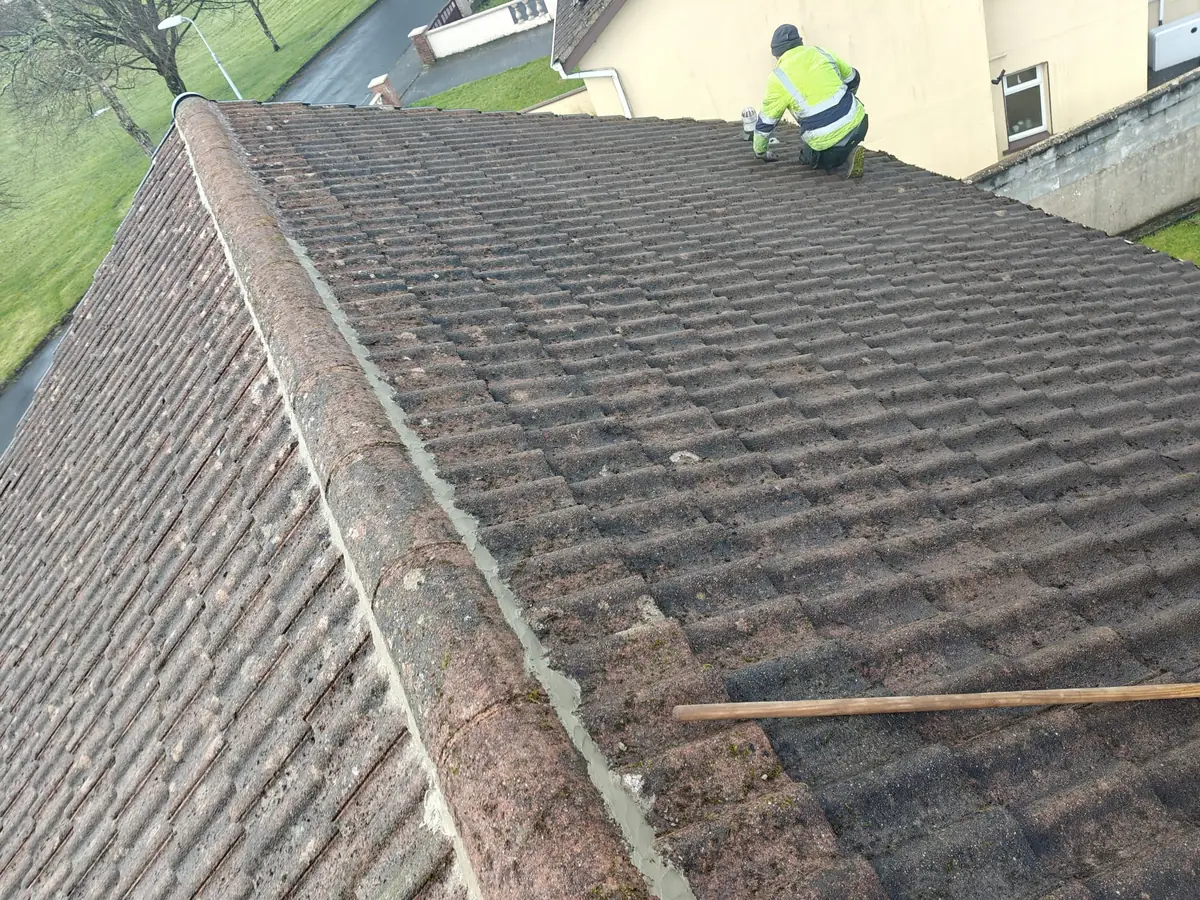

Why Wet-Bedded Mortar Ridges Blow Off in Exposed Ballycotton, Youghal and Ringaskiddy Homes
If ridge tiles keep lifting off your roof in Ballycotton, Youghal or Ringaskiddy, the fix is a mechanically fixed dry ridge system that clamps every tile to the ridge batten with stainless screws and a union strap, replacing the sand-and-cement bedding that Atlantic wind uplift keeps cracking loose. It is the current expectation on Irish re-roofs under I.S. EN 1304, and on exposed Cork coastal sites it is now the only sensible specification. Call us on 021 2040925 to arrange a free site visit and written quote.
Cork's coastal strip, from Ballycotton and Knockadoon through Youghal, Whitegate and around into Ringaskiddy and Currabinny, faces sustained Atlantic and estuarine wind loading that sand-and-cement bedding was not designed to handle over the long term.
Mortar bedding works like this:
Over successive Irish winters the mortar shrinks, hairline cracks open, water gets in and freezes, and wind pressure below the ridge pushes upward while pressure above pushes across. The bond fails at the interface between mortar and tile long before the mortar itself crumbles. On exposed coastal ridges, this failure can happen well within the expected life of the tiles.
I.S. EN 1304 and BS 5534:2014+A2:2018 now treat mortar-only bedding as inadequate on exposed sites. Every ridge and hip tile needs a mechanical fixing, a screw or clip that ties the tile back to the timber, independent of the mortar.
A dry ridge kit replaces wet mortar with three components:
The system ventilates the ridge, stops wind-driven rain being forced under the cap, and mechanically locks every ridge tile to the structure. No cement. No annual re-pointing. No lifted caps after a winter storm.
Dry verge does the same job at the gable end. Instead of mortar bedding along the barge, interlocking aluminium or plastic units clip over each tile edge and screw into the verge batten. On an exposed gable facing the Blackwater estuary or Cork Harbour, that fixing is what keeps the tile field intact after a winter storm.
I.S. EN 1304 is the European standard for clay and concrete roofing tiles, adopted in Ireland. It references BS 5534:2014+A2:2018, the code of practice for slating and tiling that Irish roofers work to. BS 5534 is unambiguous on three points:
When we re-roof a house in Ringaskiddy or Youghal, the dry system is the compliant specification. Mortar-only bedding is a defect on day one, and it will be flagged on any homebuyer's structural survey.
Our residential roofing service always quotes dry ridge and dry verge as standard on coastal Cork jobs. It is not an upsell; it is what the standard requires.
On cliff-top and headland sites such as Ballycotton and Knockadoon, and on estuarine and harbour-facing gables in Youghal, Ringaskiddy and Currabinny, we specify aluminium dry verge units rather than plastic. Salt-laden coastal air is harder on plastic roofline components than on inland sites, and aluminium holds up better over the full life of the roof. The screws and union strap are stainless steel and butyl-backed respectively, both rated for long-term coastal exposure.
On sheltered inland Cork addresses, such as a north-city semi in Blackpool or a valley-located house in Glanmire, plastic verge units with mechanical fixings remain a workable option, though we rarely specify them now even there.
Not every Cork address needs the same specification, and a proper site visit is always the right starting point. In broad terms:
If your Cork address is inland of the N25 and has never had a ridge problem in decades, the urgency is lower. But if you can see the sea from an upstairs window, the wind loading calculation is different.
A typical three-bed semi takes a two-man crew a day and a half for a full dry ridge and dry verge install. A ridge-only retrofit on an otherwise sound roof is a one-day job. Scaffolding is required in almost all cases given that ridge work is at the highest point of the building; it is always a separate, itemised line on the quote, never buried in the job price, and you are free to source it yourself if you can do so at a better rate.
The indicative ranges below come from our published price guide and apply across Cork. Every job is priced after a free site visit; the ranges are guidance only, VAT at 13.5% applies on top, and the final figure depends on access, scaffold requirement, tile compatibility and the condition of the ridge batten once inspected.
Indicative 2026 price range in euro. VAT at 13.5% applies on top. Confirm exact cost after a free site visit.
Indicative 2026 price range in euro. VAT at 13.5% applies on top. Confirm exact cost after a free site visit.
Ridge and verge retrofit work falls within the repair bracket depending on scope. A full re-roof of a three-bed semi with dry systems included sits within our full re-roofing cost guide for Cork.
See our full price guide for current indicative ranges across all roof repair and replacement work.
Two honest caveats. First, hybrid systems, mortar bedding combined with mechanical fixings, are still permitted under BS 5534 and are appropriate on heritage properties where the aesthetic of a pointed mortar joint matters. Youghal's protected structures often need this approach. The mortar is decorative; the screw does the structural work.
Second, a very sheltered inland site, a dense suburb, a valley location, a house surrounded by mature trees, can still get long life out of well-pointed mortar with mechanical fixings. If your Wilton or Bishopstown semi has never had a ridge issue in thirty years, there is no need to act urgently.
But within a couple of kilometres of the Cork coast, the wind loading data changes the calculation. The standard is clear on exposed sites, and the cost of a failed ridge after a winter storm is always higher than a retrofit before one.
Repair work carried out by Recommended Roofing carries a written guarantee of a minimum of 3 years, up to 10 years on major repair work. Replacement work carries a 10-year guarantee, and any job involving a full roof replacement also carries our Lifetime Leak Guarantee. All guarantees are written and handed over before contracts are signed, not promised afterwards. Our crews are directly employed; we do not subcontract. You can read what Cork homeowners have said about our work on our reviews page.
“For our Sunday's Well home I needed a last-minute replacement of leaking roof at the rear of a three-storey house. Recommended Roofing provided a prompt, fair estimate and — despite the wet weather — had a scaffold tower in place and the job finished in one day. The installers (David and one colleague) were efficient, courteous, and helpful throughout, and they left the site tidy, removing all waste. Very pleased with the quick response, the team, and the quality of the work. Highly recommended.”Andy Byrne, Sunday's Well, Cork, ★★★★★ on Google
The same BS 5534 standard applies on exposed coastal sites across Ireland. If you are outside Cork, see our equivalent guides:
To arrange a free site visit and written quote for dry ridge or dry verge work on your Cork roof, call us on 021 2040925 or send your details through our contact page and we will come out, inspect the ridge and batten, and price the work properly.
The mechanical components, stainless screws, aluminium verge units and butyl union strap, are rated for 40-plus years in Irish coastal conditions. That matches or exceeds the service life of the tiles themselves. Aluminium verge units are preferred over plastic on exposed Cork coastal sites because salt-laden air is harder on plastic components.
Yes. A ridge-only retrofit does not disturb the main tile field and is a one-day job for a two-man crew on a standard semi. The indicative cost falls within our roof repair range of €400 to €2,500 depending on the length of the ridge and access requirements; the exact figure is confirmed after a free site visit.
Yes. It is the compliant option under I.S. EN 1304 and BS 5534:2014+A2:2018, which Irish roofers work to. Wet-bedded mortar without mechanical fixings does not comply on exposed sites and is typically flagged on a homebuyer's structural survey.
A correctly installed dry ridge is more weathertight than mortar bedding. The butyl-backed union strap provides a continuous seal that mortar joints cannot match once they crack. Leaks on dry ridge installs almost always trace back to union strap laps that were not sealed properly at installation, which is an install fault rather than a system fault.
Ridge and verge work is not directly covered by SEAI grants. If you are carrying out a full re-roof that includes an attic insulation upgrade at the same time, the insulation element may qualify under SEAI's Better Energy Homes scheme at https://www.seai.ie/grants/. Ask your grant contractor about eligibility.
Yes, in almost all cases. Ridge work is at the highest point of the building, and safe access requires either a tower scaffold or a ridge-access scaffold. Scaffolding is always a separate, itemised line on our quote; it is never buried in the job price, and you are free to source it yourself if you can do so at a better rate.
A hybrid system uses mortar bedding for aesthetics alongside mechanical fixings to meet BS 5534. It is still permitted under the standard and is common on heritage and protected structures, such as Youghal's listed buildings, where the appearance of a pointed mortar joint is required. The mortar is decorative; the screw carries the structural load.
Repair work, including ridge and verge retrofits, carries a written guarantee of a minimum of 3 years, up to 10 years on major repair work. Replacement work carries a 10-year guarantee. Any job involving a full roof replacement also carries the Lifetime Leak Guarantee. All guarantees are in writing before contracts are signed.
If the mortar is cracking, lifting or allowing water in, and the tiles themselves are sound, a dry ridge retrofit is usually the right call. If the tiles are also deteriorating, or the battens and felt underneath are failing, a fuller assessment is needed. We carry out free site visits and give written findings before any work is agreed.
BS 5534 applies across Ireland, but the fixing schedule is graded by site exposure. Very sheltered inland sites, dense suburbs, valley locations or houses surrounded by mature trees, may be assessed differently from open coastal sites. A site visit is the right way to determine the appropriate specification for your address.
Call us on 021 2040925 or use the contact page at recommendedroofing.ie. We will arrange a free site visit, inspect the ridge, check the batten condition, and provide a written fixed-price quote. There is no obligation and no charge for the visit.
Yes. We are registered with CIRI (the Construction Industry Register Ireland), carry €6.5 million public liability insurance, and are members of the National Guild of Master Craftsmen and Guaranteed Irish. Our VAT number is IE04393055LH. We actively encourage customers to verify these details before appointing us.
Nearby areas we cover
Roof Repairs in Cork, Ireland. Free survey, written fixed-price quote, 10-year guarantee.