Roof Battens Installation in Cork
Graded Timber, Spacing and Why Cheap Battens Fail on Exposed Cork Roofs
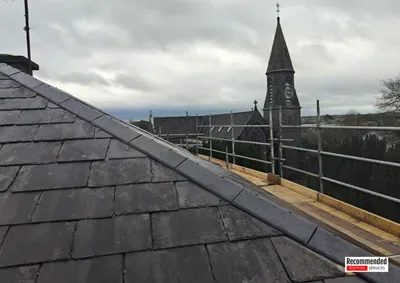

Graded Timber, Spacing and Why Cheap Battens Fail on Exposed Cork Roofs
Roof battens are the hidden structure that holds every slate or tile in place. On exposed Cork sites, the quality of that timber is the difference between a roof that lasts 60 years and one that starts failing inside a decade. We see the same story on strip-offs in Whitegate, Ballycotton and out around the Old Head peninsula: the slate looks tired, the homeowner assumes it is the slate at fault, and then we lift the first course and find ungraded, sappy, undersized battens that have twisted, split around the nail holes, or crumbled where they have stayed damp under the slate.
The slate is not the problem. The timber holding it up is.
For a standard pitched slate roof in Cork, the batten specification should cover all of the following:
Skip any one of these and you are taking a risk, especially on the west and south Cork coast where wind uplift is genuinely severe.
Here is what goes wrong when the batten spec is cut:
The case study from our Blanchardstown job tells the same story: bad battens and failed felt that went back to the original build rather than to age or a storm. A roof like that cannot be patched honestly, because there is nothing sound underneath to fix the patch to.
Ireland is split into wind zones under IS EN 1991-1-4 and the national annex. Most of coastal Cork sits in Zone 4 or Zone 5, the two highest wind-loading zones in the country. That matters because batten and fixing schedules under IS EN 5534 tighten as the zone gets harsher.
In practice, for exposed Cork sites we specify:
A homeowner in Ballinhassig does not need the same spec as one in Garrettstown, but far too many roofers apply one schedule across the whole county. Part of what we do at Recommended Roofing is confirm the wind zone before a single batten goes up.
Batten spacing, the gauge, is set by the slate length, the headlap required for your pitch and the wind zone. Indicative gauges for common natural slates on a 30° pitch with 100mm headlap are shown below. On pitches below 30°, or on any exposed Cork coastal site, headlap increases to 110mm or 115mm and the gauge tightens accordingly.
| Slate size | Headlap | Batten gauge |
|---|---|---|
| 400mm x 200mm | 100mm | 150mm |
| 500mm x 250mm | 100mm | 200mm |
| 500mm x 300mm | 100mm | 200mm |
| 600mm x 300mm | 110mm | 245mm |
Getting this wrong by even 10mm across a full roof means either exposed nail holes or wasted slate. Both are expensive to put right.
When we strip and re-cover a roof, the batten stage runs like this on every job:
That last step matters. Ten years on, if a slate slips, you know exactly what is underneath and where. It is a small thing that separates a proper installer from one cutting corners.
A recent Cork job covered both the main house and the extension, including new battens and guttering as part of the same re-roof.
The batten and underlay stage is a small part of the overall re-roof invoice but a critical one. We do not publish separate batten rates, because the correct cost depends on the roof area, pitch, wind zone and fixing schedule, and quoting a rate without seeing the roof leads to surprises on the day.
For full re-roof indicative pricing, a three-bed semi in Cork typically falls in the range of €8,000 to €18,000 for concrete tile or €12,000 to €28,000 for natural slate, both indicative and before VAT at 13.5%. Those ranges include the batten and underlay stage as a matter of course. For repair work on a sound roof, the indicative range is €400 to €2,500 depending on the scope. All figures are indicative for 2026; the actual cost is confirmed in a written fixed-price quote after a free site inspection.
See our guide to new roof costs in Cork and the Cork roof repair cost guide for more detail on what moves these figures.
Before you sign anything, ask three questions:
If the answer to any of these is vague, walk away. This is the kind of corner-cutting that turns a 60-year slate roof into a 15-year headache. Our guide on how to vet a roofer in Cork covers the wider vetting process, including what to look for in a written quote.
The three Cork areas where we most often find failed non-graded battens on strip-offs:
If your house is in any of these areas and the roof is over 20 years old with the original battens, a survey is worth doing before winter. We cover roofs across Cork city and county, including Glanmire, Carrigaline, Midleton, Bandon and Kinsale. You can browse completed jobs in our gallery or read through case studies from recent work.
Repair work at Recommended Roofing carries a written guarantee of a minimum of three years, up to ten years on major repair work. Full roof replacement work carries a ten-year guarantee plus the Lifetime Leak Guarantee. All guarantees are written and handed over before contracts are signed, not promised afterwards. Our crews are directly employed, not subcontracted.
You can read what Cork and Dublin customers say about completed work at our reviews page.
If you are looking for similar information for a roof outside Cork, see our guides for roof costs in Dublin, re-roofing in Limerick and re-roofing in Galway. All four cities are covered by Recommended Roofing's directly employed teams.
To get a batten spec checked or a re-roof quoted, request a free quote from our Cork team or ring us on 021 2040925. We will come out, survey the roof and give you a straight answer on whether it needs a repair, a partial strip or a full re-roof.
IS EN 5534 graded timber is the required standard for all pitched slate and tile roofs in Ireland. Battens must be a minimum 25mm x 50mm section, kiln-dried to 22% moisture or less, and preservative treated to Use Class 2. No stamp on the batten means it is not graded.
No. IS EN 5534 applies to all pitched slate and tile roofs regardless of exposure. Insurers and NSAI-certified installers will not sign off on ungraded timber. Sheltered does not mean safe, Cork weather changes fast.
Properly graded, treated and fixed with stainless or hot-dipped nails, battens should comfortably outlast a 60-year slate. We have stripped 50-year-old roofs where the original graded battens were still sound. Ungraded, we have seen failure inside ten years.
Yes, in almost every case. Even if the old battens look sound, the nail holes have been worked loose by decades of wind cycling. Re-using them is a false economy, the labour cost of stripping them later dwarfs the material cost of replacing them now.
On warm-roof build-ups and any roof using a non-breathable underlay, yes, counter-battens create a minimum 25mm drained and ventilated cavity above the underlay. On standard cold-roof breathable membrane build-ups, counter-battens are optional but recommended on exposed coastal sites.
For practical purposes on a Cork roof, none. IS EN 5534 is the Irish adoption of the same European standard. Timber marked BS 5534 from a UK mill is acceptable provided it meets the equivalent grade, section and treatment.
Most of coastal Cork sits in Zone 4 or Zone 5 under IS EN 1991-1-4, the two highest wind-loading zones in Ireland. Higher zones require two nails per batten per rafter crossing, ring-shank nails at eaves and verges, and staggered joints. A roofer using the same schedule as an inland county is under-specifying for Cork.
On a 30° pitch with 100mm headlap, the gauge for a 500mm x 250mm slate is 200mm centres. On a shallower pitch or an exposed coastal site, headlap increases to 110mm or 115mm and the gauge tightens. Your roofer should calculate this from the slate size and pitch before ordering timber.
Indicative 2026 ranges for a three-bed semi are €8,000 to €18,000 for concrete tile and €12,000 to €28,000 for natural slate, both before VAT at 13.5%. Those figures include the batten and underlay stage as part of the full re-roof. The actual cost depends on roof area, pitch, condition of the timbers and access.
Full replacement work at Recommended Roofing carries a ten-year written workmanship guarantee plus the Lifetime Leak Guarantee. Both are automatic and written before contracts are signed.
Warning signs include slipped or lifted slates after a storm, cold-roof condensation at the eaves, damp patches at the ceiling line and ridge cracking. A roof over 20 years old with the original battens is worth inspecting before winter, particularly on exposed Cork coastal sites.
Yes. We provide free, no-obligation written quotes across Cork city and county. The quote confirms the batten grade, section, fixing schedule and gauge before any work starts, so there are no surprises on the day.
Nearby areas we cover
Roof Repairs in Cork, Ireland. Free survey, written fixed-price quote, 10-year guarantee.